
Industrial robots move fast. They also work closer to people than ever before. That makes safety planning essential. ISO 10218-2:2025 sets out how organizations should design, integrate, and operate robot cells safely.
This page explains what the standard covers, what has changed, and how your organization can apply it.
What Is ISO 10218-2:2025?
ISO 10218-2:2025 is an international safety standard. It is published under ISO/TC 299 Robotics. It sets safety requirements for industrial robot applications and robot cells.
The standard focuses on integration. It covers how a robot is combined with other equipment, tooling, and safeguarding to form a working robot cell.
ISO 10218-2:2025 is the current edition. The previous edition, ISO 10218-2:2011, has been withdrawn and replaced.
It works alongside ISO 10218-1:2025, which covers the robot itself. Together, the two standards form a complete safety framework for industrial robotics.
What Changed in ISO 10218-1:2025?
ISO 10218-2:2025 covers the full lifecycle of a robot application. This includes:
- Design: Planning the layout, safeguarding, and safety functions of the robot cell.
- Integration: Combining the robot, end-effectors, and other equipment into one working system.
- Commissioning: Checking that the robot cell works as intended before it goes live.
- Operation: Using the robot cell in normal production conditions.
- Maintenance: Servicing and adjusting the cell without creating new hazards.
- Decommissioning and disposal: Safely shutting down the robot cell at the end of its life.
Safety is not a one-time task. It runs from the first design decision to the final shutdown.
What Is Outside the Scope?
ISO 10218-2:2025 does not cover every type of robot or every hazard.
It does not replace the robot manufacturer’s requirements under ISO 10218-1:2025. It also does not cover non-industrial robots, such as those used in medical, military, or consumer settings.
Some hazards, like general electrical safety in a facility, may fall under other standards. Check which standards apply to your full operation, not just the robot cell.
What Is a Robot Application in ISO 10218-2:2025?
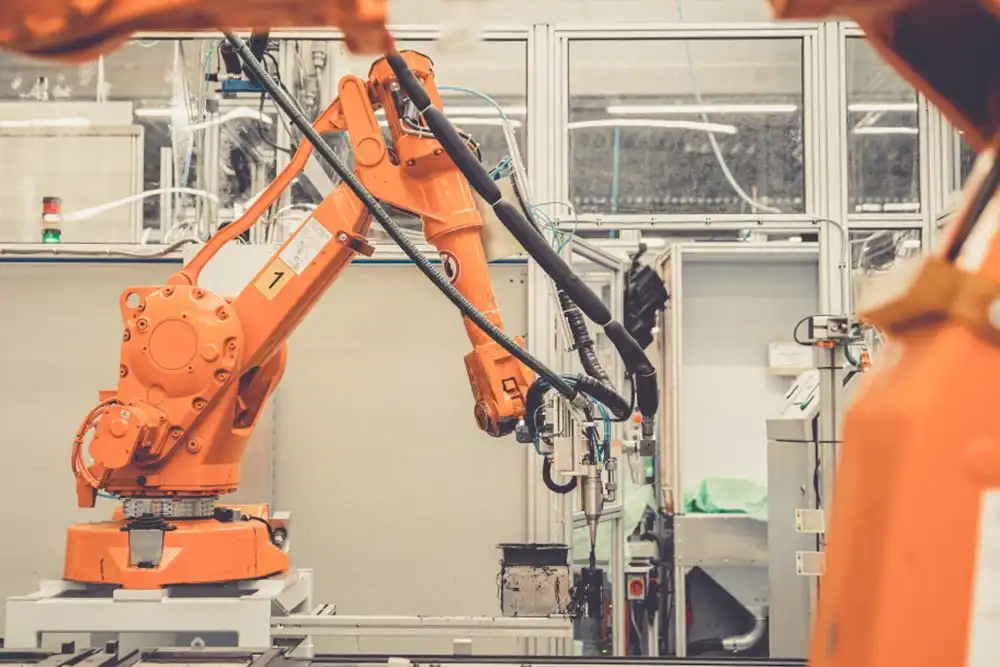
A robot application, sometimes called a robot cell, is the complete working system built around an industrial robot.
It includes the robot, any end-effectors (like grippers or tools), safeguarding equipment, and the surrounding workspace. It also covers how people interact with that space — whether they enter occasionally or work alongside the robot.
Treating your robot application as a whole system is the first step toward meeting the standard.
What Changed in ISO 10218-2:2025?
The 2025 edition updates and replaces the withdrawn 2011 edition. Always confirm the exact changes against the published standard. That said, several high-level shifts are worth noting.
Lifecycle Coverage Is More Explicit
The 2025 edition covers the full lifecycle of a robot application — from design through disposal. The 2011 edition focused mainly on integration and commissioning.
Terminology and Structure Have Been Updated
Terms and structure have been updated to align with current industry practice and with related standards in the ISO 10218 series.
Task-Based Risk Assessment Is More Central
The 2025 edition places greater emphasis on risk assessment for specific tasks performed within the robot cell. The 2011 edition took a more general robot cell approach.
Review the full published text of ISO 10218-2:2025 before making compliance decisions.
ISO 10218-2:2025 vs ISO 10218-2:2011 – What Is the Difference?
| Area | ISO 10218-2:2011 (Withdrawn) | ISO 10218-2:2025 (Current) |
| Status | Withdrawn | Current, active edition |
| Lifecycle focus | Integration and commissioning | Full lifecycle: design through disposal |
| Risk assessment | General robot cell approach | Task-based risk assessment |
| Terminology | Earlier industry terms | Updated to current practice |
| Alignment | Earlier edition of ISO 10218-1 | Aligned with ISO 10218-1:2025 |
If you still reference the 2011 edition, plan to move to ISO 10218-2:2025. Confirm the exact requirements in the current published text.
ISO 10218-1:2025 vs ISO 10218-2:2025
These two standards work together but cover different responsibilities.
ISO 10218-1:2025 covers the robot itself. It is mainly written for robot manufacturers.
ISO 10218-2:2025 covers the robot application — the full robot cell as integrated and operated. It is mainly written for integrators and end users.
Put simply: ISO 10218-1 asks, “Is this robot safe by design?” ISO 10218-2 asks, “Is this robot cell safe to use?”
ISO 10218-2:2025 and Collaborative Applications
Collaborative applications involve robots working in the same space as people, often without full physical barriers between them.
ISO 10218-2:2025 addresses collaborative applications as part of its broader coverage. Supplementary technical guidance is available in ISO/TS 15066. Note that ISO/TS 15066 is currently under review and is expected to be replaced by a future standard.
Collaborative operation relies on recognized methods. These include safety-rated monitored stop, hand guiding, speed and separation monitoring, and power and force limiting. The specific requirements for each method vary by application. Always confirm them against the current published standards.
A robot marketed as a “cobot” is not automatically safe for collaborative use. Every collaborative application needs its own risk assessment and validation.
Key Safety Topics in ISO 10218-2:2025
Task-Based Risk Assessment
Focus your risk assessment on the specific tasks performed in and around the robot cell. Cover normal operation, maintenance tasks, and occasional interventions like clearing a jam.
Safeguarding
Safeguarding includes the physical and procedural measures that keep people safe near the robot cell. Options include fencing, light curtains, interlocked gates, and safety-rated sensors. The right choice depends on your application.
Safety Functions
Safety functions stop or limit robot motion when a hazard is detected. Verify them as part of your robot cell design. Do not assume they are correctly configured based on the robot’s general specifications alone.
End-Effectors
End-effectors — such as grippers, welding tools, or cutting tools — add their own hazards. Include them in your risk assessment for the robot cell.
Manual Load and Unload Stations
These are the points where people manually interact with the cell. They often bring people closest to the robot’s working range. Give them careful attention in your design.
Verification and Validation
Once the robot cell is built, verify and validate it. Confirm that it performs as designed and that all safety measures work correctly before regular production begins.
Who Is Responsible Under ISO 10218-2:2025?
Responsibility is shared, but the roles are clear.
The integrator designs and builds the robot cell. This includes selecting safeguarding, integrating end-effectors, and verifying the completed cell.
The end user operates and maintains the robot cell. This includes training staff, following maintenance procedures, and reporting safety issues.
Some organizations act as both integrator and end user. This is common in smaller manufacturers who build and run their own robot cells. In those cases, the organization holds both sets of responsibilities.
Is ISO 10218-2:2025 a Certification?
ISO 10218-2:2025 is a safety standard. It is not a certification scheme.
Organizations do not receive a stand-alone “ISO 10218-2 certificate.” The standard is a technical reference used to design, build, and operate robot cells safely.
Some organizations also pursue management system certifications, such as ISO 45001 for occupational health and safety. These provide a formal, auditable framework that can support robot cell safety practices.
Who Uses ISO 10218-2:2025?
ISO 10218-2:2025 is used by:
- Robot integrators designing and building robot cells
- Manufacturing companies operating robot cells
- Automotive, electronics, and logistics companies using robotic automation
- Health and safety professionals responsible for workplace risk assessment
- Consultants and auditors reviewing robot cell safety
Any organization that designs, builds, operates, or maintains an industrial robot cell should understand this standard.
How Can Companies Apply ISO 10218-2:2025 to a Robot Cell?
Step 1: Define the Robot Application
Describe the robot cell clearly. Identify the robot, end-effectors, surrounding equipment, and how people will interact with the space.
Step 2: Conduct a Task-Based Risk Assessment
Assess risks for each task performed in and around the cell. Include normal operation, maintenance, and manual interventions.
Step 3: Select Appropriate Safeguarding
Choose safeguarding measures that match the identified risks. Options include fencing, interlocks, sensors, or a combination.
Step 4: Design and Verify Safety Functions
Check that the robot’s safety functions are configured for your specific application — not just the robot’s default settings.
Step 5: Integrate End-Effectors Safely
Review how the end-effector interacts with the task and environment. Address any hazards it introduces.
Step 6: Plan for Manual Load and Unload Points
Give extra attention to areas where people interact with the cell manually. These often need additional safeguarding.
Step 7: Verify and Validate the Completed Cell
Test the cell against its design before production starts. Confirm all safety measures work as intended.
Step 8: Train Staff and Document Procedures
Train operators and maintenance staff. Document procedures for normal operation, maintenance, and emergencies.
ISO 10218-2:2025 and Regulatory Compliance
ISO 10218-2:2025 is a technical safety standard. It is not a legal requirement on its own.
Legal requirements vary by country and sector. The standard is often used as part of a broader compliance strategy. It should be used alongside relevant regulations — not as a replacement for them.
Always confirm which local or national regulations apply to your robot cell.
Checklist Before Applying ISO 10218-2:2025
Before starting your robot cell safety project, confirm:
- You have identified whether your application is collaborative or fully guarded
- You have described every task performed in and around the cell
- You know who holds integrator and end user responsibilities
- You have reviewed the current published text of ISO 10218-2:2025
- You have checked whether ISO 10218-1:2025 requirements apply to your robot supplier
- You have considered whether management system certifications like ISO 45001 support your safety goals
- You have identified any local or industry regulations that apply beyond the standard
How Can ISO Certifications UAE Support ISO 10218-2:2025 Requirements?
Applying ISO 10218-2:2025 to a real robot cell requires structured support. ISO Certifications UAE works with organizations across the UAE to help them move forward with confidence. Support includes:
- Standards interpretation: Helping your team understand how ISO 10218-2:2025 applies to your robot application.
- Gap review: Identifying where your current design or documentation falls short of the standard’s requirements.
- Documentation support: Assisting with risk assessments, safety procedures, and verification records.
- Related management system certifications: Supporting organizations pursuing ISO Certification Services, including ISO 9001, ISO 45001, and ISO/IEC 27001, which can complement your robot cell safety program.
Our consultants work with manufacturing, automotive, electronics, and logistics companies across the UAE.
Get Support for ISO 10218-2:2025 and Robot Cell Safety Standards
Robot cell safety requires clear guidance and careful planning. ISO Certifications UAE helps organizations in Dubai, Abu Dhabi, Sharjah, and across the UAE apply ISO 10218-2:2025 with confidence.
Contact our team to discuss your robot application safety requirements.
ISO 10218-2:2025 Frequently Asked Questions
Is ISO 10218-2:2025 mandatory?
ISO 10218-2:2025 is a voluntary international standard. However, contracts, clients, or regulations may reference it. In those cases, meeting its requirements can become effectively necessary.
Does ISO 10218-2:2025 replace ISO 10218-2:2011?
Yes. ISO 10218-2:2011 is withdrawn. ISO 10218-2:2025 is the current edition and should be used going forward.
Who needs to follow ISO 10218-2:2025 — the integrator or the end user?
Both. Integrators are responsible for designing and building the robot cell. End users are responsible for safe operation and maintenance.
Can a small manufacturer apply this standard without a certification body?
Yes. The standard is a technical reference, not a certification scheme. Organizations can apply it internally. Expert guidance helps ensure accuracy.
Does ISO 10218-2:2025 cover collaborative robots?
Yes. Collaborative applications are addressed within the standard. Supplementary guidance is available in ISO/TS 15066.
How does ISO 10218-2:2025 relate to ISO 45001?
ISO 10218-2:2025 sets technical safety requirements for robot cells. ISO 45001 provides a broader occupational health and safety management system. The two can work together.
Where can I get help applying this standard to my facility?
ISO Certifications UAE offers standards interpretation, gap review, and documentation support for your robot application.